
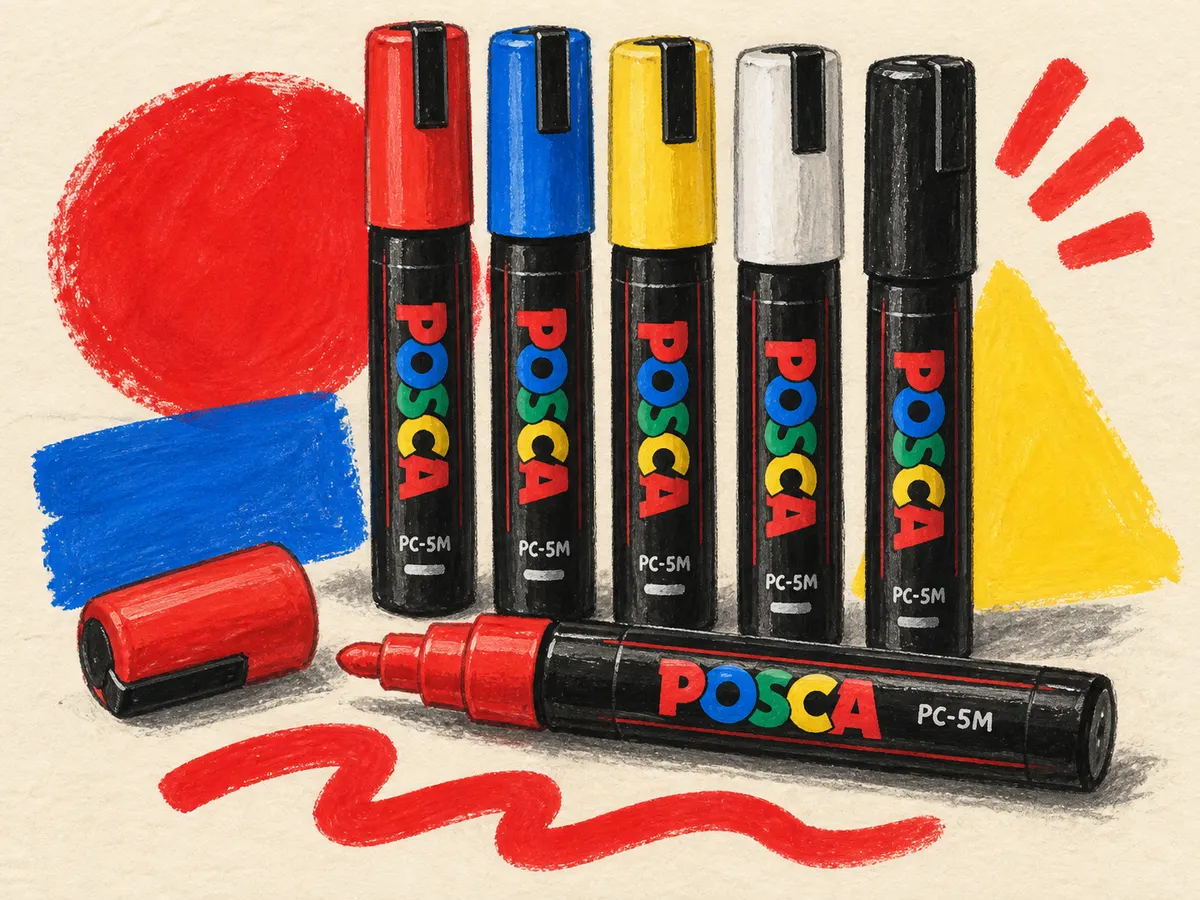
The best set of Posca markers is the one whose tips fit your project. A tiny nib can turn a broad fill into a chore. A broad nib can make a small drawing feel clumsy. I would settle that choice before counting colors.
For a first few markers, the PC-5M is a sensible place to start. It puts a medium bullet tip around opaque, water-based paint. Draw a line, fill a shape or add a clear mark over a dry layer. You do not need a palette.
What makes Posca paint markers different?
Good fit: A versatile 1.8–2.5 mm tip with opaque water-based paint.
Keep in mind: Not refillable; permanence depends on the surface.
Posca paint markers hold water-based paint. The paint is held in the barrel and fed through a tip with a valve. Shake the capped pen, then prime it on scrap material so the paint reaches the nib.
That is a different experience from a dye-based alcohol marker. Posca is useful for opaque marks and flat color; alcohol ink is better suited to transparent layers and blended shading. If you want the latter, the Ohuhu markers guide will help you choose the right starting point.
I like Posca most for a few bold marks. Think of an edge on card, a pattern on wood or a light detail over a dark dry layer. For a broad painted background, a brush may be faster.
PC-5M: a medium bullet tip for daily use
The PC-5M has a 1.8–2.5 mm tip. That width gives you some freedom between line work and small fills. Its bullet tip is reversible, which can help extend its useful life when one end wears.
It would be my first choice for someone who wants to find out how paint markers fit their work. Try a few colors, plus black and white if you use them often. That can tell you a lot before you buy a large set.
The catch: a medium bullet tip is still a medium bullet tip. It will not do the same work as a needle-fine point. If most of your drawing involves tiny letters or facial details, begin with a finer marker instead.
The Posca range: choose your tip size
| The mark you want | Tip choice to look for |
|---|---|
| Small letters and tiny details | Extra-fine or fine |
| Everyday outlines and small fills | Medium bullet, such as PC-5M |
| Changes from thin to broad strokes | Brush |
| Big lettering and wider fills | Broad or chisel |
The official Posca range is worth checking before buying a mixed set. Match the stated tip size and shape to your project, and check whether a pack gives you one size or several.
One well-chosen extra tip is often more useful than ten more colors in the wrong size. Start with the work you plan to make this week. You can build a wider collection after the gaps become clear.
Paper, wood, glass: the surface changes the result
Posca paint works on many surfaces, but that does not mean every mark has the same permanence. The maker distinguishes porous materials, where paint can hold, from smooth non-porous surfaces, where it may remain removable.
On paper and card, test how much wet paint the surface can take. On wood, dust and surface treatments can affect the result. On glass and smooth plastic, do not assume that a dry mark will survive handling, washing or scraping.
Follow the maker’s instructions for the exact material and try a small patch first. A sealer can change both the look and the way the paint behaves. “Dry” and “ready for daily wear” are not the same thing.
If you want to decorate a clay ornament, let the clay dry fully first. Our air-dry clay guide explains which materials suit small objects and why a painted finish does not make them useful foodware.
Prime on scrap, not on the finished piece
Shake the marker with its cap on. Remove the cap and press the tip gently on scrap paper until the paint feeds through. Give it time; repeated hard pumping can put out more paint than you want.
Make a few test marks before moving to your work. If the line becomes dry partway through a project, move back to the scrap sheet to restore the flow. It is much easier to deal with an extra blob there than in the middle of a finished drawing.
Cap the pen when you pause. A little care with the nib matters more than squeezing one last mark out of a dry tip.
Painting light colors over dark colors
Opaque Posca paint makes it tempting to correct everything at once. Wait until the first layer is dry before adding the next. A damp base can mix with a new color or get disturbed by the nib.
Thin paper needs particular care. In an artist’s Posca review and tutorial, repeated work over damp paper caused its surface to pill. That is a useful reminder to pause between layers rather than trying to force coverage with more strokes.
Test light colors over dark ones before making the mark that matters. You may need a second dry layer. Coverage varies with the color, the base and how much paint reaches the tip.
For larger areas and colors mixed on the spot, I would choose a brush and one of these gouache paints. A marker buys you convenience and a fixed tip; a palette buys you more freedom to mix.
Are Posca markers refillable?
Posca says its markers are not refillable. That matters if you expect to use a lot of one color. A set can look good value until the white or black runs out well before the others.
Before replacing a marker that has stopped flowing, check the nib. A dry tip does not always mean an empty barrel. The Posca FAQ gives advice on moistening, cleaning and re-priming tips, including which models have replaceable or reversible parts.
Follow the guidance for your model. Do not pull apart a marker just because a video shows someone refilling a different one. Keep the cap secure and store brush-tip versions as the maker directs.
What about fabric and skin?
Fabric needs its own preparation and fixing instructions. Test the paint and the fixing method on a hidden patch, and check the fabric’s care label before using heat. A decorative result is not a promise that it will survive every wash.
Do not use Posca as face paint or body paint. The maker states that the markers are not certified for cosmetic use. Keep them for the art and craft surfaces they were made for.
Fine point, bullet tip or brush tip?
A tip size tells you about width. The shape tells you how that width behaves. Posca markers with a bullet tip give you a rounded point for steady outlines. A brush tip bends with your hand and can change the stroke more freely. Both are useful creative tools, but they ask for different control.
For fine lines, the PC-1MR has a calibrated 0.7 mm point. I would consider it for small lettering or a final detail on dry artwork. A fine point makes little sense for painting a whole background: it takes more strokes, more time and more patience.
The PCF-350 brush tip suits flowing marks and calligraphy. It is worth considering if you enjoy painting with a flexible brush but want the paint held in one tool. A brush tip is less like a firm drawing pen, so test the pressure on scrap first.
For larger marks, compare the broad sizes in the Posca range. Choose a bullet tip for rounded strokes or a chisel shape for flat edges. A set of many colors in one tip size will not replace these different shapes. My starting point remains the PC-5M bullet tip, with one fine marker added when a project needs it.
Posca paint on glass, plastic and ceramic
On smooth glass, Posca paint can be useful for temporary decoration. Clean the glass, test a mark and find out how easily it can be removed before making the whole design. A vase you only display is different from a glass you wash each day.
Plastic varies a lot. A smooth plastic storage box and a rough plastic model may not hold paint in the same way. Surface treatments can change the result too. Test the specific plastic rather than relying on a claim that a marker works on virtually anything.
For ceramic, follow Posca's ceramic guidance for that surface. Do not transfer a baking method from one type of object to another. Decoration belongs away from food-contact areas unless the whole finished item is proven suitable for that use.
I would start with Posca paint markers on an indoor display piece. Outdoor objects face more wear. Washing, scraping, sunlight and rain are separate tests. A mark that looks good today does not answer all four questions.
Painting wood, rocks, canvas and cardboard
Wood and rocks can make good surfaces for bold patterns. Remove dirt and loose dust first. On rough materials, a fine point may catch or wear quickly; a medium bullet tip can be a more useful choice. Test whether the surface absorbs the paint unevenly before drawing a detailed pattern.
Canvas needs a similar check. Its weave can affect a fine line, and a flexible support can move under pressure. I would try a small mark on the same prepared canvas before adding Posca paint to a finished painting. Avoid pressing hard to force paint into a gap.
Cardboard is handy for a first color study or a quick sign. It also shows why painting and drawing need different amounts of liquid. Thin cardboard can buckle when wet. Build the colors with light coats and let the work dry between them.
Try a simple red shape with a blue outline, or white marks on black card. These small studies show how opaque colors cover your chosen base. Two coats may look better than one heavy coat. Check the dry result, not just the wet shine.
Do you need varnish or a spray finish?
A finish is a separate product choice. Read the surface guidance, the varnish label and the instructions for the object you are painting. Check that the products are compatible before coating a finished creation.
A spray can avoid dragging a brush over paint, but it has its own directions for distance, ventilation and drying. Brush-on varnish may be easier to control on a small object. Neither is a promise of a waterproof or food-safe result. Test the finish on spare material first.
I would leave a paper drawing unvarnished unless there is a clear reason to coat it. Protecting it from rubbing and damp may solve the problem with fewer materials. On decorative objects, choose the finish for the planned use, not just the shine.
Pick a useful set of colors
Start with colors that fit one project. Black, white and a few main colors may cover more ideas than a large mixed set with gaps in the shades you need. Think about which color will run out first. Replacing one well-used marker can make more sense than buying the same set again.
The broader range includes special finishes, but check the exact marker and tip size before buying. Metallic, fluorescent and glitter options do not necessarily come in every size. I would add a special finish after learning how the basic Posca paint behaves on the material.
For creative hobbyists, a small set is an easy way to explore self-expression without laying out brushes and jars. For an artist making repeat work, consistency matters more. Record the color, tip size and surface to help match the next piece.
The price of a set should reflect useful items, not just a large count. Check duplicate colors, tip sizes and replacement availability at the store. A creative tool earns its place by fitting the work you actually want to create.
The purchase I would make
I would start with a small PC-5M set for bold drawing and everyday craft work. Then I would add a finer point only if the medium tip kept getting in the way of the details.
Posca earns its place when you want opaque color in a compact tool. The limits are just as clear: you cannot refill it, its permanence depends on the surface, and it rewards patience between layers. Buy for those traits, and the choice of set becomes much simpler.